
WRITING
Artist statements are notoriously difficult. It’s hard to gain perspective on your own work when you’re in the process of making it, and often there isn’t time to get any distance before the next application or exhibition statement is due. Let me help you! I love writing about other artists’ works. Take a look at some examples of my writing below.
I like to think that artist-run organizations are contemporary cave paintings.

Some of our earliest examples of art were products of—and for—group activity. A single Paleolithic cave painting was often the work of many artists, as evidenced by the multiple handprints on cave walls and the varying stylistic choices and levels of proficiency. Neolithic henges and megalithic structures would have certainly required group efforts to create. Rather than evidence of occupation, the structures’ orientations often relate to the changing of seasons and suggest religious or ritualistic purposes. Throughout the ancient world and for many centuries of the Common Era, guilds, workshops, and teams of artisans created works together that were both quotidian and great. We have primarily made art in groups—until relatively recently.
The shift from art as a communal activity to an individualistic endeavor has Western historical and cultural roots. According to Larry Shiner in The Invention of Art: A Cultural History, “Art,” as we know it today, was invented by the West. Since at least the Enlightenment (and perhaps even earlier, with Vasari and the Renaissance masters), great Western artists have been viewed as solitary geniuses, alone possessing a unique gift to share with the world.
I won’t have time to discuss the specifics of whether or not this is actually true. But even if it is true, is that the dynamic we want between our special objects of material culture, their makers, and our communities?
Today, across the world aesthetic items are produced in workshops by small collaborative groups, often following longstanding formal traditions. These objects are mostly relegated to a “craft” classification rather than “art.” Such distinctions do more than separate objects based upon their physical qualities or technical methods; the categories also reinforce social hierarchy and class. I probably don’t need to furnish citations to make the claim that many everyday Americans find contemporary art confusing and disconnected from their lives and values. Shiner might argue that separation is by design…
Painter Rebecca Sedehi’s Artist Statement
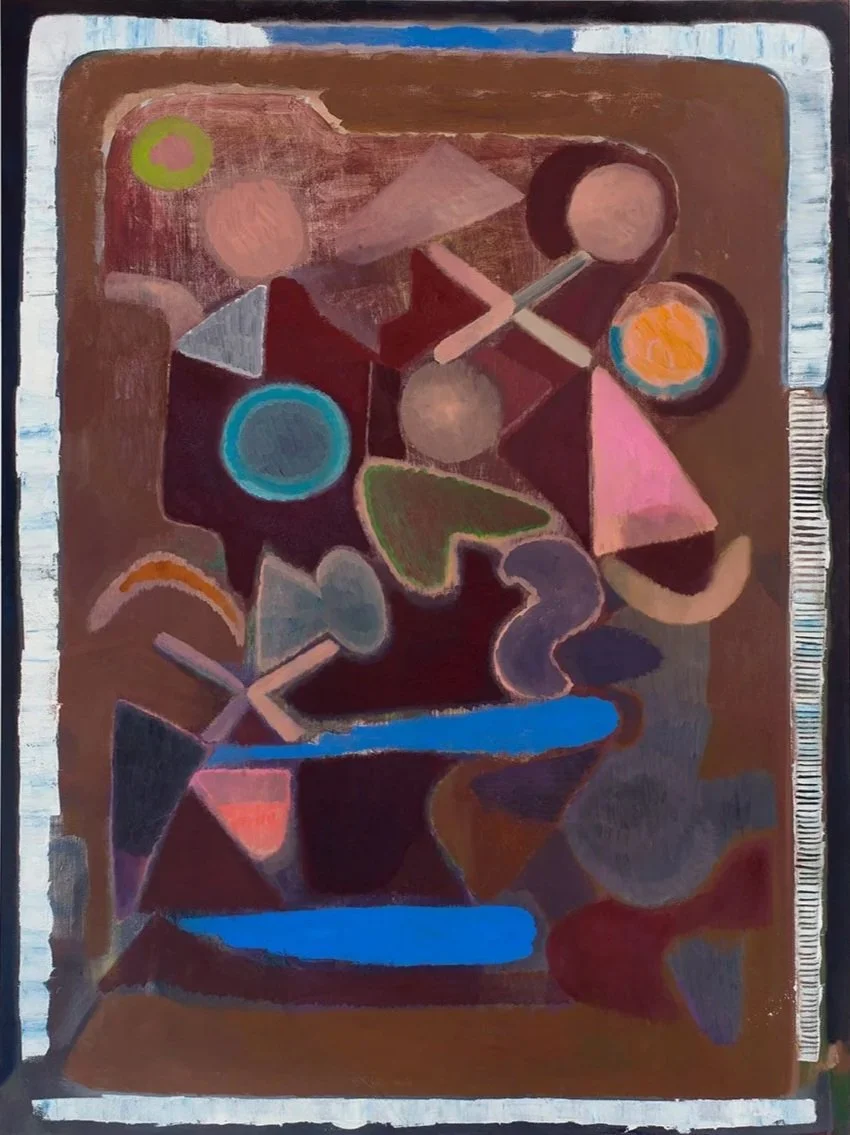
I’m fascinated with the ancient practice of symbolic creation and the sacred quality of handmade objects. Drawing from forms, both foreign and familiar, I create paintings that attest to both my mortal imperfection and psychic interdependence with the visual and material world.
Forms are embedded with knowledge and history, manifesting as visual landmarks, invented mythologies, and nonverbal truths. Beginning with still life and landscape studies, I investigate symbols, shape, patterns and color until a language of tacit, immaterial concepts emerge, a kind of poetic reasoning.
In our virtual world, my practice creates space and time for a quiet intelligence to arrive. Instead of what is measurable, programmed or coded, my work embraces a handmade imperfection as a conduit between maker and viewer. The ordered and structured tumble into an elusive and sensory experience.
Rebecca Sedehi, 2024, oil on canvas, 48 x 36 in.
Press Release for Interwoven by Bethann Parker at Gross McCleaf Gallery | May 2024
The surfaces of Parker’s paintings are rich, dynamic, and complex. She enjoys harvesting materials from her local environment and produces her own charcoal sticks, rabbit and venison glues for sizing, and pigments, from scratch. She also incorporates lesser-known products such as shellac, marble dust and distemper into her works, explaining, “Materials have feelings and behave in certain ways. The fluidity of distemper says something very different than a beefed-up marble oil stroke; natural gesso has a sinking absorbency of weight compared to the delicate ‘topholding’ of linen.” Parker poetically combines these tactile topographies with a broad variety of pictographs, granting endless opportunities to portray multi-faceted narratives.
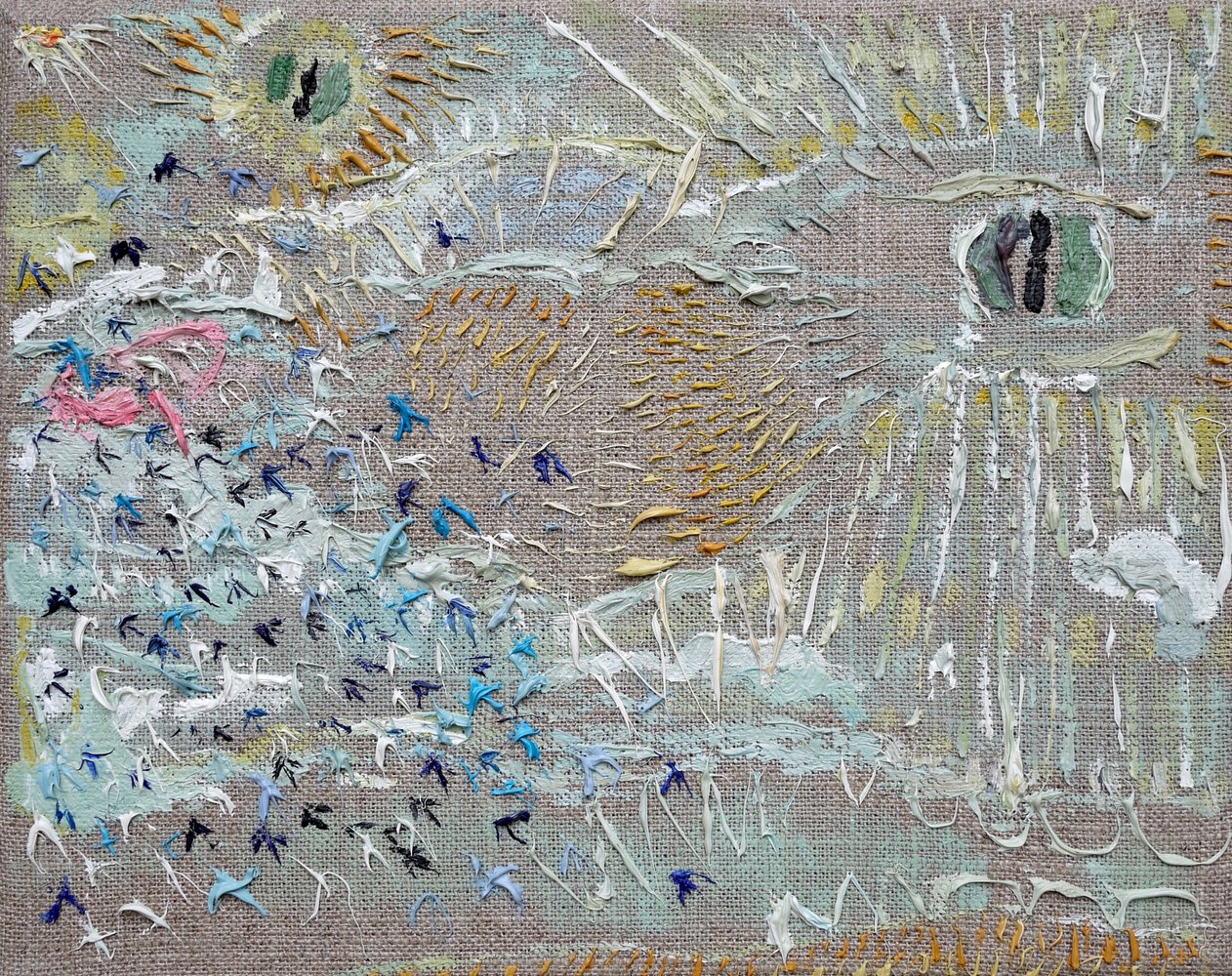
Parker masterfully weaves together an assortment of disparate symbolism in her works. Angels, trees, animals, windows, earthly elements, and water in all its forms, are stitched together in thoughtful arrangements, and meticulously applied to great effect. Often appearing as the landscape, subtly indicated forms can serve dual functions. In the bistable imagery of Woven Flight, an exaltation of larks swoops into a sparsely indicated, sunny sky while the face of a mammalian creature emerges – perhaps a “sky cat” focused on the cluster of delicious prey.
The surfaces of Parker’s paintings are rich, dynamic, and complex. She enjoys harvesting materials from her local environment and
produces her own charcoal sticks, rabbit and venison glues for sizing, and pigments, from scratch. She also incorporates lesser-known products such as shellac, marble dust and distemper into her works, explaining, “Materials have feelings and behave in certain ways. The fluidity of distemper says something very different than a beefed-up marble oil stroke; natural gesso has a sinking absorbency of weight compared to the delicate ‘topholding’ of linen.” Parker poetically combines these tactile topographies with a broad variety of pictographs, granting endless opportunities to portray multi-faceted narratives.
Parker masterfully weaves together an assortment of disparate symbolism in her works. Angels, trees, animals, windows, earthly elements, and water in all its forms, are stitched together in thoughtful arrangements, and meticulously applied to great effect. Often appearing as the landscape, subtly indicated forms can serve dual functions. In the bistable imagery of Woven Flight, an exaltation of larks swoops into a sparsely indicated, sunny sky while the face of a mammalian creature emerges – perhaps a “sky cat” focused on the cluster of delicious prey.
Bethann Parker, Woven Flight, 2024, oil on linen, 8 x 10 in.
Selections from PR for Nocturne, a group show at Gross McCleaf Gallery | October 2022
Autumn is once again cooling the air, drawing long shadows across sidewalks covered in leaves, and expanding the period of darkness between each day. Before winter conditions take hold, this season provides an opportunity to relish in the romantic beauty and mysterious character of the night.
Kelly Micca paints on location with a battery-operated desk lamp pointed towards her palette and canvas. In Harvest Moon, a bright full moon radiates against a tiny detail of City Hall in the background. In another work, majestic purple clouds fill three-quarters of the picture while a sunset disappears behind the blue light of the Wells Fargo Center. In her documentation of the finest nighttime visions of Philadelphia, the hazy lights at a Wawa gas pump glisten as the red logo glows with the promise of snacks and lottery tickets.
Kate McCammon’s soft fiber paintings depict night scenes outside the city. In Backyard, two lawn chairs and a table conjoin into a geometric abstract shape. They rest on a lawn spotted with glittering speckles of light. Her stretcher bars are curled up in sheets of velvet, silk, and upholstery fabric that embrace the rectangular wooden structure like a warm duvet.
Thoughtfully inviting slowness, Tess Wei’s paintings defy straightforward description. As a combination of oil, flashe, and wax with shells and sand collected by the artist off the coast of Newfoundland, Wei’s textural pieces exist as both object and picture plane. Although space and form emerge from the varied black surfaces, the shapes remain unnamable. There is a sense of blindly navigating a room, feeling around in the dark.
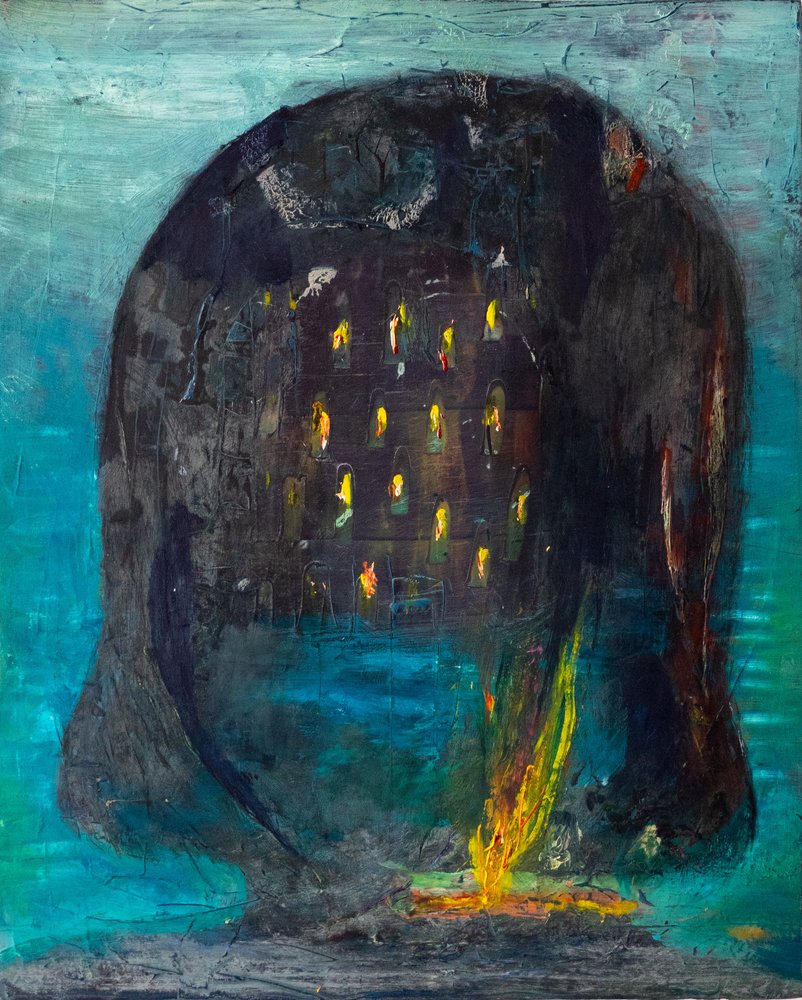
The witching hour has arrived in Kimi Pryor’s dream-like, hallucinatory narratives. Pryor utilizes thick, heavily worked layers of oil paint. At times, she scrapes and sands her canvases, revealing unexpected shapes and ghost-like forms from the substrates of past lives. Pryor’s imagery takes cues from the Surrealists, pursuing unexpected combinations of objects. Interpretation is open–ended. To Pryor, the work offers a fictive space in which stories can originate.
Kimi Pryor, Monument, 2022, oil on panel 20 x 8 in.
Post-Apologetic, a group show at AUTOMAT | January 2016
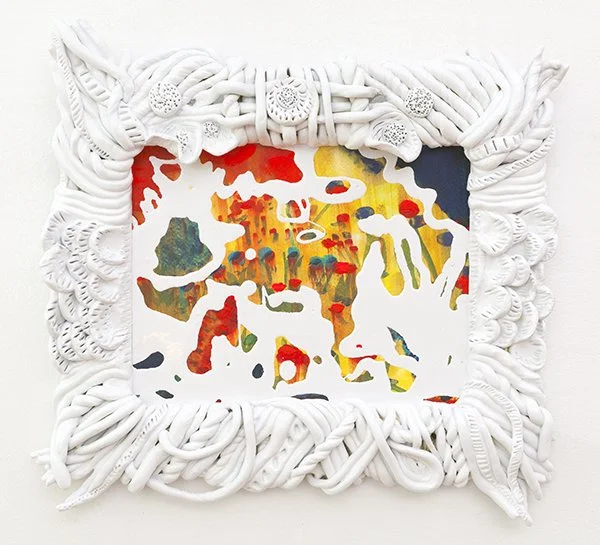
Crafty, cliched symbols; big, ornate frames; the Sunday painter’s still lifes; and paintings swathed in petroleum-based fabrics hang together unashamed of their pejorative descriptions in Post Apologetic. The artists in this show embrace these qualities in their works to allow us to reconsider what could be viewed as flamboyant, wasteful, or trite.
The works tangentially grace four sides of their substrate and offer mostly two-dimensional surfaces. They are positioned comfortably into Painting - the discipline that has been “dead but won’t lay down” for several decades now.
So, we are “sorry, not-sorry” to exhibit the works of Paul DeMuro, Kati Gegenheimer, Leeza Meksin and Rebecca Saylor Sack in Post Apologetic, January 8th - February 19th.
Kati Gegenheimer, Gift Drawing For Odilon Redon, 2015, acrylic and enamel on paper with handmade one-of-a-kind frame